Who Owns the Trees Between the Street and Your Fence? How to Actually Find Out
Who owns the strip between the street and your fence is really three questions: ownership, easements, and maintenance. Here is how your plat, survey, CC&Rs, and title commitment answer each, plus the Texas tree basics.
It is one of the most common questions homeowners ask, and one of the most commonly wrong-answered: who owns the trees in that grassy strip, the one between the street and the sidewalk, or between your privacy fence and the road behind it? Neighbors will confidently tell you it is the county, the HOA, the MUD, or you, and in any given subdivision each of them might be right. Here is how to stop guessing.
Three different questions hiding in one
"Who owns the trees" is really three separate questions, and they regularly have three different answers:
- Who owns the land under the tree. Ownership is set by the recorded plat and your deed, not by who mows it.
- Who holds an easement over it. A utility easement or street right of way gives someone else rights over land you may own, including, sometimes, the right to trim or remove vegetation in it.
- Who is required to maintain it. CC&Rs and local rules often assign maintenance to someone other than the owner. Maintaining a strip for years does not, by itself, make it yours, and owning it does not always make the upkeep someone else's problem.
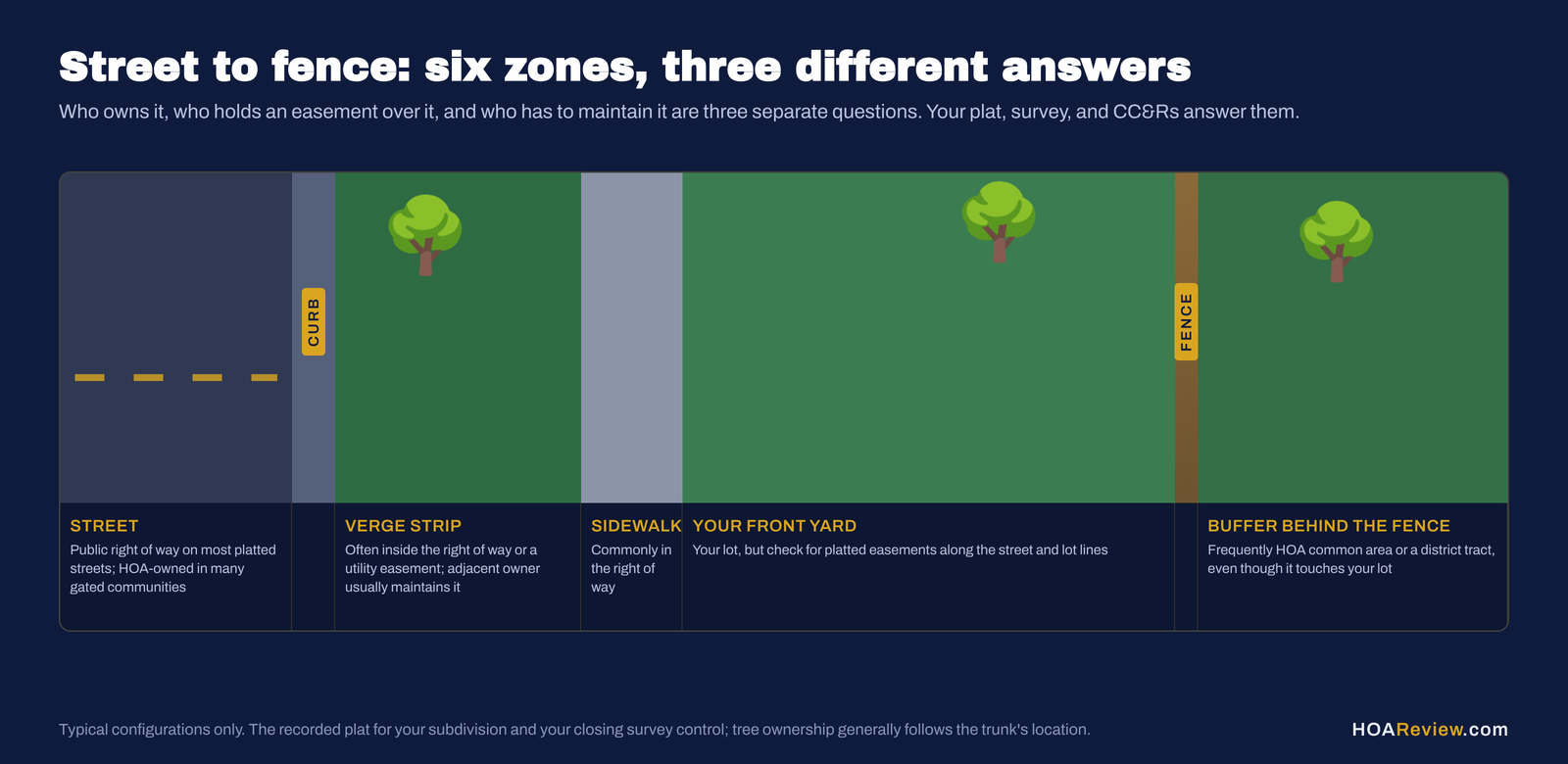
The zones, and what they usually are
- The strip between curb and sidewalk, often called the verge or right of way sod, commonly sits inside the platted street right of way or a utility easement. The adjacent homeowner usually handles mowing and watering even where the underlying land is not theirs.
- The sidewalk itself is commonly inside the right of way as well.
- Your front yard is your lot, but check the plat: easements frequently run along the street frontage and lot lines.
- The grassy buffer behind a privacy fence, common in master-planned communities, is frequently not part of your lot at all: it is often an HOA common area tract or a special district tract, even though your fence touches it.
- In gated communities with private streets, the association rather than the public commonly owns the street and the strips beside it.
Every one of those is a "commonly", not an "always". Your subdivision's recorded plat is the document that turns commonly into actually.
How to find your answer in under an hour
- Pull the recorded plat. It shows every lot line, right of way width, easement, and separately owned tract in your subdivision. Your county clerk's office has it, and many county appraisal districts link it from the parcel page.
- Find your survey. You almost certainly received one at closing. It draws your exact lot, with easements, in one page.
- Check the county appraisal district's map. Searching the parcel viewer for the strip in question often shows a separate parcel owned by the HOA, a district, or a government entity, which answers the ownership question immediately.
- Read the CC&Rs' maintenance sections. They say what the association maintains and what owners must maintain, which is the duty question, separate from ownership.
- Look at your title commitment's Schedule B. It lists the recorded easements that burden your lot specifically.
And the trees themselves?
For trees in Texas, the starting rules are short, per the Texas State Law Library: the location of the trunk generally determines who owns the tree, though there can be exceptions. A neighbor may trim branches that extend over the property line, but could be sued for injuring the tree or other property in the process, so trimming someone else's tree is a careful-hands job, not a chainsaw job. Cities may regulate tree removal within limits set by Texas Local Government Code Sec. 212.905, certain counties can restrict clear-cutting live oaks in unincorporated areas under Sec. 240.909, and your association's covenants may add their own tree maintenance rules on top.
So before you cut, plant, or push back on a violation notice:
- Locate the trunk against the plat and your survey. The trunk's location, not the branches, generally decides ownership.
- Read the CC&Rs and get architectural approval in writing if removal or planting needs it.
- If the tree stands in a right of way or easement area, ask the city, county, or utility in writing before touching it.
- Call 811 before you dig or plant. It is free, and Texas's one-call system applies to excavation.
- Get the HOA's answer in writing. If the association says the strip is theirs, that email is worth keeping.
This article is general information, not legal advice; property boundaries and easements are exactly the kind of question a Texas real estate attorney or your title company resolves definitively.
When an HOA communicates boundaries, maintenance duties, and tree rules clearly, conflicts like this never start. How well does yours? Leaving a review on HOAReview documents it for your neighbors and for the next buyer.
Sources: Texas State Law Library, Neighbor Law guide, Trees; Texas Local Government Code Secs. 212.905 and 240.909.